Save taxes with Real Estate: Key levers for doctors
.jpeg)

Doctors are among the highest-earning professional groups in Germany—and consequently, among those who pay the most in taxes. However, many medical professionals underestimate how significantly this burden can be reduced through targeted tax optimization for doctors when rental properties are used strategically.
While private investments like ETFs and Rürup pensions already achieve significant effects (see article 1, Top Tax Tips 2026 for Doctors), real estate also offers numerous tax-saving opportunities for doctors.
In this article, we show how real estate, modernization, depreciation, and financing can be used to legally save large amounts of tax and convert them into long-term wealth.
Real estate as a tax opportunity
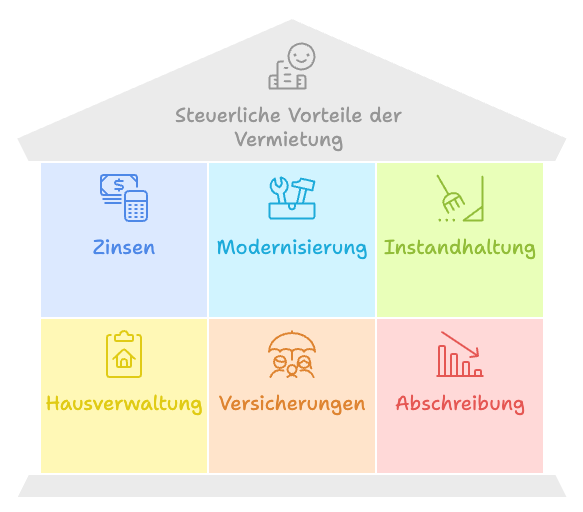
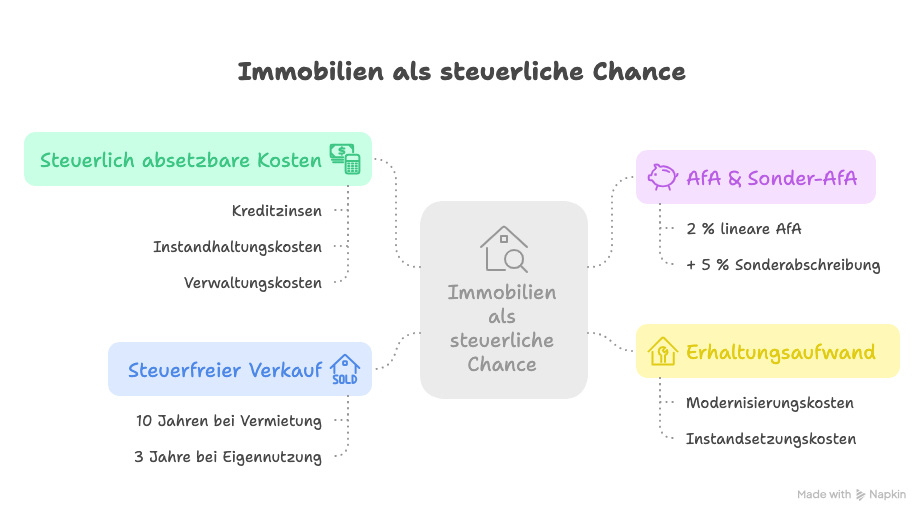
Real estate has always been considered one of the most solid investments and offers doctors not only stability but also significant tax advantages. Anyone who rents out a propertycan claim a variety of costs for tax purposes: from mortgage interest and maintenance measures to administrative costs, annual depreciation on the building value, and special depreciation allowances. This significantly reduces the tax burden while increasing the profitability of the property.
Tax savings through depreciation – Section 7b EStG
A key central lever for tax optimization is the Depreciation (AfA). It allows you to claim the acquisition and construction costs of a property for tax purposes over the years. An additional benefit is the special depreciation under Section 7b of the German Income Tax Act (EStG), which applies to newly constructed or energy-efficiently renovated rental properties. In addition to the regular straight-line depreciation of 2% per year, an extra 5% special depreciation can be claimed during the first four years.
It adds up:
For a property with acquisition costs of €300,000, for example, €55,000 is allocated to the land, €230,000 to the building, and €15,000 to the kitchen and furnishings.
Using regular straight-line depreciation, 2% of the building portion can be written off annually, which amounts to €4,600 per year.
The special depreciation under Section 7b is added on top during the first four years: an additional 5% per year on the building portion, which is about €11,500 in extra annual deductions.
If the apartment is also equipped with a kitchen and furniture for €15,000, these items can be depreciated over ten years at 10% per year, providing another €1,500 in annual deductions.
In total, this results in approximately €107,000 in depreciation over ten years, which, at a personal tax rate of 42%, corresponds to a tax saving of around €45,000. In the first four years alone, while the special depreciation is in effect, the depreciation amounts to around €70,000, resulting in about €30,000 in tax savings. A significant effect that demonstrates how powerful tax incentives can be when building a real estate portfolio.
Especially for doctors with a high income tax burden, it is therefore worthwhile to strategically incorporate depreciation options into their wealth planning.
Tax-free property sales after ten years
Another advantage is the tax treatment of profits from property sales. Anyone who holds a property for at least ten years can sell it in Germany completely tax-free. Owner-occupied properties can be sold tax-free after three years of personal use . However, apart from the sale, no other tax benefits can be claimed for owner-occupied properties.
Assuming the value of a property increases by 2% annually (the average historical value growth in Germany) over 10 years, from €300,000 to €366,000. If the profit of €66,000 were taxed at a personal tax rate of 42%, that would amount to approximately €28,000 in taxes. After the ten-year holding period has expired, this amount is eliminated entirely, the the entire capital gain remains tax-free.
Maintenance costs as a tax advantage for real estate
A particularly interesting way to leverage real estate for tax purposes is through so-called maintenance costs. If you purchase an unrenovated existing property and subsequently modernize or renovate it, you can claim the incurred costs for tax purposes—partly immediately and partly spread over several years. The crucial factor is that the measures serve the purpose of repair rather than fundamental expansion and do not exceed 15% of the purchase price. For doctors with a high tax burden, the targeted purchase of properties in need of renovation can therefore be an effective way to reduce current income tax while simultaneously building wealth.
Doctors benefit from special financing terms
Another advantage lies in the financing. Due to their stable income, doctors are classified by banks as having high creditworthiness. This leads to more favorable interest rates and flexible repayment models, which make real estate investments even easier. With the right financing strategies, the leverage effect can be optimally utilized, as interest is tax-deductible and the invested capital creates long-term added value.
Assuming the €300,000 property is 100% financed by the bank, including furnishings. With an interest rate of 4.5% and an initial repayment rate of 1%, this results in an annual installment of €16,500, or €1,375 per month.
This installment is divided into interest and repayment. In the first year, €13,500 of this goes toward interest and €3,000 toward repayment. The repayment is not an expense, but rather builds equity in the property.
The interest portion, on the other hand, can be claimed as income-related expenses for tax purposes. With approximately €13,500 in interest in the first year and a marginal tax rate of 42%, this results in a tax saving of around €5,700 from the interest deduction alone.
As repayment progresses, the interest portion decreases year by year because the installment remains constant and the repaid portion increases. In total, however, around €128,000 in interest is still paid over ten years. At a marginal tax rate of 42%, this corresponds to a total tax saving of around €54,000 over the entire period from the interest deduction alone.
Other ongoing property costs
In addition to financing and depreciation, there are ongoing costs for a rented property. Some of these can be passed on to the tenant as operating costs, such as property tax, waste disposal, or building insurance. However, another portion remains with the landlord and reduces their net income.
For example, the following costs are incurred:
- Property management: approx. €25 per month
- Maintenance reserve: approx. €20 per month
- Insurance and account management (residential building and legal expenses insurance): approx. €55 per month
These costs are also tax-deductible and reduce your taxable income. With a marginal tax rate of 42%, the government effectively covers around €500 per year of these expenses.
The impact of the tax effect
The individual components only reveal their true impact when viewed together. Only a complete calculation shows what a rental property actually costs and what the final outcome will be.
It is useful to look at this on two levels: the equity investment before taxes and the actual cash flow after taxes, which shows what you really need to contribute from your own funds.
It is important to remember: the property is rented out and generates rental income that must be taxed. Only by looking at this balance do you get the real picture.
Assume the example property generates €850 in base rent per month, or €10,200 per year.
This is offset by financing costs of €16,500 and ongoing expenses of around €1,200. Before taxes, this results in an annual shortfall of around €7,500, or about €625 per month, which must be paid out of pocket. However, this payment already includes about €3,000 in principal repayment, which is not a loss but rather the building of equity in the property.
After taxes, the picture changes significantly. Due to interest and depreciation, there is an initial tax loss of around €22,100 per year.
With a marginal tax rate of 42%, this leads to a tax refund of €9,300.
In the first few years, the property almost pays for itself. Over ten years, this effect weakens because the special depreciation under Section 7b only applies during the first four years. On average, after taxes, there remains a real out-of-pocket payment of €117 per month over 10 years. The government covers the rest through tax savings, while at the same time, wealth is being built through principal repayment.
Conclusion
As a doctor, you can effectively save on taxes with rental properties. The interplay of depreciation, financing, and ongoing management reduces the actual financial burden while building wealth through principal repayment. The key is to ensure that all aspects are correctly taken into account.
In this example, real figures have been simplified and rounded. A positive example was deliberately chosen to show what is possible. However, there are numerous properties on the market where the math does not work out, and what was supposed to be a tax-saving model ends up being a costly loss-making venture. It is these details that determine whether an investment works or not.
This is exactly where a professional advisor should provide support: by realistically evaluating every property, checking the crucial details, and ensuring that nothing is overlooked. This creates a comprehensive concept that works in the long term and fits your personal situation, rather than turning out to be a poor decision years later.
In addition to the levers shown here, there are of course numerous other ways for doctors to save on taxes and build wealth through targeted investments. It is all about finding the right balance, and this is exactly where a good advisor should provide support. Our experts guide you through this process and help develop the right combination for your personal situation. If you would like to dive deeper, you can find more tax-saving models in our article "Top Tax Tips 2026 for Doctors".
- weitere Artikel


Get to know us personally
At Wealth Doctors, we understand how demanding your daily routine is. That's why we start by informing you about your options on the market, with no pressure at all, and help you make sense of your situation. If evenings work better for you, we'll find a slot even after a late shift.
If you like what you hear, we might work together, if not, that's okay too.